Koala: A Craft Fair-Ready Wild Animal Embroidery Design
First Impression: Minimal, Bold, and Instantly Recognizable
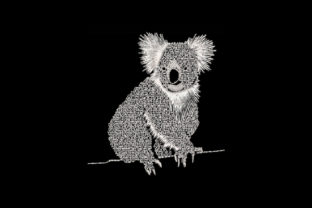
As an embroidery designer who’s prepped over 200 craft fair booths—from Portland bazaars to Nashville maker markets—I opened the Koala design file and smiled. It’s not fussy. No tiny eyelashes, no layered fur gradients, no nested outlines. Just clean, confident shape language that reads *koala* at 3 feet—and even better at 12 inches on a tote bag. It lands somewhere between modern minimalist and friendly rustic: soft enough for a baby gift bundle, bold enough to hold its own beside hand-lettered signage at a busy booth. That single-color execution isn’t a limitation—it’s a strategic advantage for speed, consistency, and visual impact.
Where Koala Shines in Real Craft Fair Products
Koala thrives where simplicity meets storytelling. On a heavyweight cotton tote bag? Perfect focal point—centered just below the strap seam, it reads cleanly without competing with logos or slogans. On a linen apron? It adds warmth without overwhelming the functional silhouette. For tea towel embroidery, Koala works best as a lower-corner accent (not centered), letting the fabric’s texture shine while the koala anchors the composition with quiet charm.
It’s especially strong on curved or structured items: caps, pouches, and pillow covers. Why? Because the absence of fine interior detail (no stitched eyes or nose) eliminates risk of distortion on rounded surfaces or dense weaves. I’ve seen too many “cute animal” designs blur on baseball caps—the Koala avoids that trap entirely. As an embroidered patch? Excellent. Clean edges, low stitch density, and strong silhouette mean it’ll hold up through washing, ironing, and repeated pinning.
What Makes Koala a Smart Batch-Production Choice
- Speed: “Quick to stitch” means faster turnarounds—critical when you’re embroidering 40+ tote bags the night before a Saturday market.
- Consistency: One thread color = fewer thread changes, less chance of mismatched batches, and seamless color coordination across product lines (e.g., matching koalas on tea towels and pouches).
- Photography-friendly: High contrast against dark fabric translates beautifully to Etsy listings and Instagram posts. No need for heavy editing—just natural light and a clean background.
- Repeatable appeal: Koala feels fresh but never trendy. It won’t date your brand or confuse repeat buyers. Customers return for more because it feels like part of a cohesive, thoughtful collection—not a one-off novelty.
Careful-Use Notes Every Embroiderer Should Know
Koala is forgiving—but not magic. Here’s where attention matters:
- Dark fabric only: The description is precise—no stitching in eye/nose areas means those zones rely entirely on fabric contrast. On anything lighter than charcoal, the koala loses definition and reads as a vague shape, not a koala.
- Fabric texture matters: Avoid highly napped or terry cloth towels. The clean outline needs a smooth surface to land crisply. Medium-weight cotton twill or linen-cotton blends are ideal.
- Size scaling: Koala holds up well from 3”–5”, but under 2.5” it begins to lose its signature silhouette. Don’t shrink it for tiny keychain patches unless you’ve tested it on your machine first.
- Hoop size & stabilizer: Even simple designs need proper support. Use medium-weight cutaway stabilizer for tote bags and aprons; tear-away works for tea towels and lightweight pouches. Always confirm hoop size compatibility before loading—some versions may require a 4x4 or larger.
Booth Impact & Buyer Engagement
In a crowded craft fair aisle, Koala stands out by being *calm*. While glittery fonts and hyper-detailed florals compete for attention, Koala invites pause. Shoppers slow down, tilt their heads, smile—and that’s your opening. It sparks conversation (“Is that an Australian koala?” “Do you have it on pillows?”), builds connection, and signals quality: clean lines = intentional design = trusted handmade product.
Pair it thoughtfully: a dark indigo tote with Koala + matching navy tea towel + charcoal pouch = instant gift set. That cohesion strengthens your booth’s visual rhythm and makes upselling intuitive. Buyers don’t just buy a koala—they buy into your aesthetic. And because Koala fits naturally within the Wild Animals category without feeling zoological or juvenile, it bridges age groups and styles—equally at home in a kids’ boutique or a modern farmhouse shop.
Practical Designer Notes Before You Stitch
This isn’t just about loading a file and hitting start. As someone who’s re-stitched entire booth runs due to overlooked details, here’s my checklist:
- Test the machine embroidery design on scrap fabric *identical* to your production material—especially for darks. Thread contrast shifts dramatically between black cotton and deep-navy linen.
- Review spacing: Does the design clear seams, pockets, or curved edges on your chosen product? A 5” Koala centered on a small pouch may crowd the zipper.
- Create at least one real mockup—not just a printable mockup. See how it drapes, how light hits the stitches, how it feels in hand.
- Compare fabric colors side-by-side: Charcoal, navy, espresso, and black all read differently under market tent lighting.
- Confirm commercial licensing status *before* selling finished products. This embroidery file must be cleared for resale use—not just personal projects.
- Inspect stitch density visually: Even “quick” designs can pack tight fills. If your machine hesitates or threads break during testing, adjust tension or stabilizer weight—not the design itself.
Final Thought: Koala Is More Than a Design—It’s a Craft Fair Asset
Koala delivers what every handmade seller needs: clarity, charm, and consistency. It’s the kind of craft fair product that sells itself—not because it shouts, but because it resonates. It elevates a plain tote into a keepsake, turns a tea towel into a conversation starter, and gives your Etsy seller profile a distinct, memorable anchor. In a sea of complex digital embroidery files, Koala reminds us that sometimes the strongest statement is the simplest one—stitched with intention, designed for real life, and built to sell.